

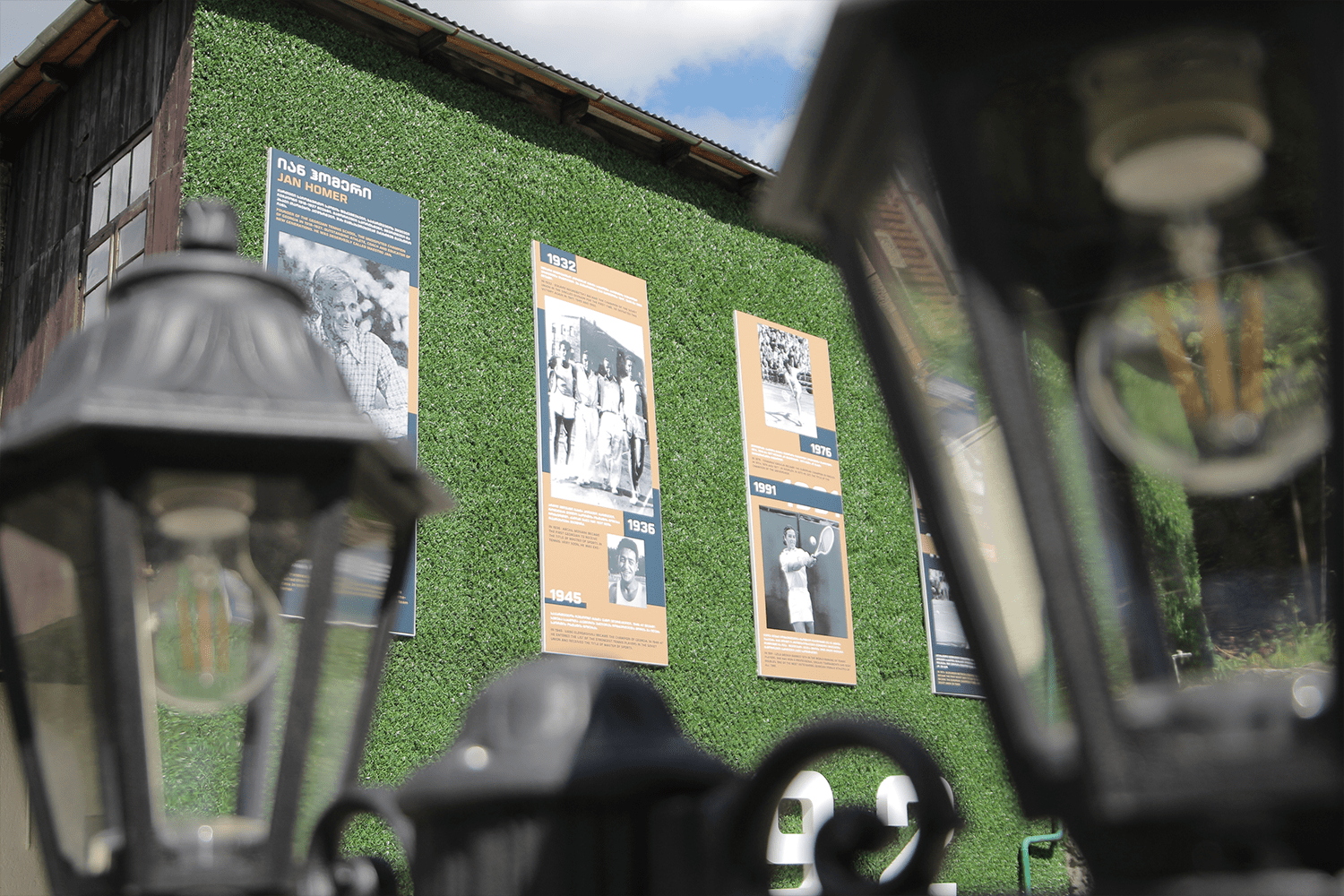
An open museum was opened in Chiatura, in the historical place of the city, where the first tennis court in Georgia was located in 1892. According to the decision of the "Georgian Manganese", a non-standard 400 m² court was organized, which combines the history of Georgian tennis in one space.
Within the framework of the project, the surrounding area was cleaned, the old historical wall, the steps of the stairs, the privately owned building were restored, a recreational area with green plants was organized, as well as a rest area, from where the views of the city of Chiatura can be clearly seen.
In the territory of the museum-court, in the same space, there is a symbolic painting, various types of informational walls, on which the history of the court is written, as well as important information about tennis player Ian Homer, who held worked in Chiatura.
Ian Homer has a special place in the history of Georgian tennis. At the age of thirteen, he was already the champion of Chiatura, and at the age of twenty, for ten years, he was the unchanging champion of Tbilisi and Georgia until 1927. Later, his students, outstanding tennis players Eduard Negrebetski and Archil Mdivani, took over the championship.
The development of tennis in Georgia began at the end of the 19th century, after the manager of the English firm "Forward and Salinas" John Tarsey introduced the new game to the residents of Chiatura. Afterwards English people built the first tennis court in Chiatura. It was in Chiatura that Ian Homer got acquainted with tennis. The development of the Georgian tennis school started with his initiative.
First was Chiatura, then Tbilisi, Batumi and later other cities. The idea of building a tennis museum-court belongs to "Georgian Manganese". The works in the mentioned area were carried out with the financial support of this company. The company has been working within the framework of corporate social responsibility for years, and the construction of the museum-court is part of this responsibility. The management of the museum court will be handed over to Chiatura municipality.


